According to Film Art Realism Is the Most Useful Standard for Evaluating Actorsã¢â⢠Performances
A film – too chosen a movie, motion-picture show, flick, or photoplay – is a work of visual art that simulates experiences and otherwise communicates ideas, stories, perceptions, feelings, beauty, or atmosphere through the use of moving images. These images are generally accompanied past sound and, more than rarely, other sensory stimulations.[i] The word "cinema", short for cinematography, is often used to refer to filmmaking and the film industry, and to the art class that is the result of it.
Recording and transmission of film
The moving images of a film are created past photographing actual scenes with a motility-picture photographic camera, past photographing drawings or miniature models using traditional blitheness techniques, past means of CGI and computer animation, or by a combination of some or all of these techniques, and other visual effects.
Earlier the introduction of digital production, serial of still images were recorded on a strip of chemically sensitized celluloid (photographic motion picture stock), ordinarily at the charge per unit of 24 frames per 2d. The images are transmitted through a movie projector at the same rate equally they were recorded, with a Geneva bulldoze ensuring that each frame remains still during its short projection time. A rotating shutter causes stroboscopic intervals of darkness, but the viewer does non notice the interruptions due to flicker fusion. The credible motion on the screen is the event of the fact that the visual sense cannot discern the individual images at high speeds, so the impressions of the images blend with the dark intervals and are thus linked together to produce the illusion of one moving paradigm. An analogous optical soundtrack (a graphic recording of the spoken words, music and other sounds) runs along a portion of the flick exclusively reserved for information technology, and was not projected.
Contemporary films are usually fully digital through the entire process of production, distribution, and exhibition.
Etymology
The proper name "pic" originally referred to the thin layer of photochemical emulsion[2] on the celluloid strip that used to be the actual medium for recording and displaying motion pictures.
Many other terms exist for an private movement-moving-picture show, including picture, motion picture evidence, moving picture, photoplay, and flick. The most common term in the United states of america is movie, while in Europe film is preferred. Archaic terms include "blithe pictures" and "animated photography".
Common terms for the field in general include the big screen, the silver screen, the movies, and movie theater; the terminal of these is commonly used, every bit an overarching term, in scholarly texts and critical essays. In early on years, the word sheet was sometimes used instead of screen.
History
Precursors
The art of film has fatigued on several earlier traditions in fields such as oral storytelling, literature, theatre and visual arts. Forms of art and entertainment that had already featured moving and/or projected images include:
- shadowgraphy, probably used since prehistoric times
- camera obscura, a natural miracle that has possibly been used as an artistic aid since prehistoric times
- shadow puppetry, possibly originated around 200 BCE in Key Asia, India, Indonesia or Prc
- The magic lantern, adult in the 1650s. The multi-media phantasmagoria shows that utilized magic lanterns were popular from 1790 throughout the get-go one-half of the 19th century and could feature mechanical slides, rear projection, mobile projectors, superimposition, dissolving views, alive actors, smoke (sometimes to project images upon), odors, sounds and even electric shocks.
Before celluloid

Animated GIF of Prof. Stampfer's Stroboscopische Scheibe No. 10 (Trentsensky & Vieweg 1833)
The stroboscopic animation principle was introduced in 1833 with the stroboscopic disc (ameliorate known as the phénakisticope) and later applied in the zoetrope (since 1866), the flip book (since 1868), and the praxinoscope (since 1877), before it became the basic principle for cinematography.
Experiments with early phénakisticope-based animation projectors were made at least every bit early as 1843 and publicly screened in 1847. Jules Duboscq marketed phénakisticope projection systems in France from circa 1853 until the 1890s.
Photography was introduced in 1839, but initially photographic emulsions needed such long exposures that the recording of moving subjects seemed impossible. At least as early equally 1844, photographic serial of subjects posed in different positions have been created to either suggest a move sequence or to certificate a range of different viewing angles. The appearance of stereoscopic photography, with early experiments in the 1840s and commercial success since the early 1850s, raised interest in completing the photographic medium with the addition of ways to capture colour and motion. In 1849, Joseph Plateau published about the idea to combine his invention of the phénakisticope with the stereoscope, as suggested to him by stereoscope inventor Charles Wheatstone, and to use photographs of plaster sculptures in different positions to be animated in the combined device. In 1852, Jules Duboscq patented such an instrument as the "Stéréoscope-fantascope, ou Bïoscope", but he only marketed it very briefly, without success. One Bïoscope disc with stereoscopic photographs of a automobile is in the Plateau collection of the Ghent Academy, but no instruments or other discs accept nevertheless been found.

An animated GIF of a photographic sequence shot by Eadweard Muybridge in 1878. His chronophotographic works tin be regarded as very curt movies that were recorded before at that place was a proper way to replay the material in motion.
By the late 1850s the outset examples of instantaneous photography came virtually and provided hope that motion photography would soon exist possible, simply it took a few decades earlier it was successfully combined with a method to record serial of sequential images in real-time. In 1878, Eadweard Muybridge eventually managed to have a series of photographs of a running horse with a battery of cameras in a line forth the track and published the results equally The Horse in Motion on cabinet cards. Muybridge, as well as Étienne-Jules Marey, Ottomar Anschütz and many others would create many more chronophotography studies. Muybridge had the contours of dozens of his chronophotographic serial traced onto glass discs and projected them with his zoopraxiscope in his lectures from 1880 to 1895. Anschütz adult his own Electrotachyscope in 1887 to project 24 diapositive photographic images on glass disks as moving images, looped as long as accounted interesting for the audience.
Émile Reynaud already mentioned the possibility of projecting the images of the Praxinoscope in his 1877 patent awarding . He presented a praxinoscope projection device at the Société française de photographie on iv June 1880, but did not market his praxinoscope a projection before 1882. He then further developed the device into the Théâtre Optique which could project longer sequences with separate backgrounds, patented in 1888. He created several movies for the car by painting images on hundreds of gelatin plates that were mounted into cardboard frames and attached to a textile band. From 28 October 1892 to March 1900 Reynaud gave over 12,800 shows to a total of over 500,000 visitors at the Musée Grévin in Paris.
Showtime motion pictures

By the end of the 1880s, the introduction of lengths of celluloid photographic film and the invention of move movie cameras, which could photograph a rapid sequence of images using only one lens, allowed action to exist captured and stored on a single compact reel of film.
Movies were initially shown publicly to ane person at a fourth dimension through "peep show" devices such as the Electrotachyscope, Kinetoscope and the Mutoscope. Not much afterwards, exhibitors managed to project films on big screens for theatre audiences.
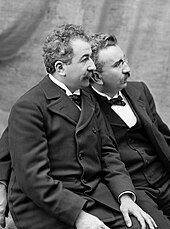
The first public screenings of films at which admission was charged were made in 1895 by the American Woodville Latham and his sons, using films produced by their Eidoloscope company,[3] and by the – arguably better known – French brothers Auguste and Louis Lumière with 10 of their own productions.[ citation needed ] Private screenings had preceded these past several months, with Latham's slightly predating the Lumière brothers'.[ commendation needed ]
Early on evolution
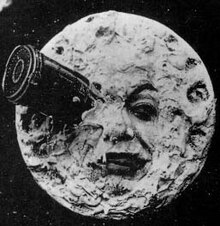
The primeval films were simply one static shot that showed an outcome or activity with no editing or other cinematic techniques. Typical films showed employees leaving a factory gate, people walking in the street, the view from the front of a trolly every bit it traveled a metropolis's Main Street. Co-ordinate to legend, when a film showed a locomotive at loftier speed approaching the audience, the audience panicked and ran from the theater. Around the turn of the 20th century, films started stringing several scenes together to tell a story. (The filmmakers who commencement put several shots or scenes discovered that, when ane shot follows another, that human activity establishes a relationship between the content in the separate shots in the minds of the viewer. Information technology this relationship that makes all pic storytelling possible. In a simple example, if a person is shown looking out a window, whatever the next shot shows, it will be regarded as the view the person was seeing.) Each scene was a single stationary shot with the action occurring before information technology. The scenes were afterwards broken up into multiple shots photographed from different distances and angles. Other techniques such as camera move were adult as effective ways to tell a story with pic. Until sound moving picture became commercially practical in the tardily 1920s, motion pictures were a purely visual art, but these innovative silent films had gained a concord on the public imagination. Rather than leave audiences with just the racket of the projector every bit an accessory, theater owners hired a pianist or organist or, in large urban theaters, a full orchestra to play music that fit the mood of the film at any given moment. By the early on 1920s, almost films came with a prepared list of sail music to be used for this purpose, and complete film scores were composed for major productions.
The rise of European cinema was interrupted past the outbreak of World War I, while the film industry in the United States flourished with the rise of Hollywood, typified most prominently by the innovative work of D. W. Griffith in The Birth of a Nation (1915) and Intolerance (1916). Nevertheless, in the 1920s, European filmmakers such every bit Eisenstein, F. Due west. Murnau and Fritz Lang, in many ways inspired by the meteoric wartime progress of flick through Griffith, along with the contributions of Charles Chaplin, Buster Keaton and others, apace caught up with American flick-making and continued to farther accelerate the medium.
Sound
In the 1920s, the development of electronic sound recording technologies made information technology practical to incorporate a soundtrack of spoken language, music and sound effects synchronized with the action on the screen.[ citation needed ] The resulting sound films were initially distinguished from the usual silent "moving pictures" or "movies" past calling them "talking pictures" or "talkies."[ citation needed ] The revolution they wrought was swift. Past 1930, silent motion-picture show was practically extinct in the Us and already existence referred to as "the old medium."[ commendation needed ]
Color
Another major technological development was the introduction of "natural color," which meant colour that was photographically recorded from nature rather than added to black-and-white prints by hand-coloring, stencil-coloring or other capricious procedures, although the primeval processes typically yielded colors which were far from "natural" in appearance.[ citation needed ] While the advent of audio films quickly made silent films and theater musicians obsolete, color replaced black-and-white much more gradually.[ commendation needed ] The pivotal innovation was the introduction of the three-strip version of the Technicolor procedure, offset used for animated cartoons in 1932, then also for live-action short films and isolated sequences in a few feature films, and so for an entire feature motion picture, Becky Abrupt, in 1935. The expense of the process was daunting, merely favorable public response in the form of increased box part receipts usually justified the added toll. The number of films made in color slowly increased year later on year.
1950s: growing influence of television
In the early 1950s, the proliferation of black-and-white television started seriously depressing North American theater attendance.[ citation needed ] In an attempt to lure audiences back into theaters, bigger screens were installed, widescreen processes, polarized 3D projection, and stereophonic audio were introduced, and more films were made in color, which presently became the rule rather than the exception. Some important mainstream Hollywood films were still existence fabricated in black-and-white equally late as the mid-1960s, but they marked the end of an era. Colour television receivers had been bachelor in the US since the mid-1950s, but at first, they were very expensive and few broadcasts were in color. During the 1960s, prices gradually came down, color broadcasts became common, and sales boomed. The overwhelming public verdict in favor of color was clear. After the final flurry of blackness-and-white films had been released in mid-decade, all Hollywood studio productions were filmed in colour, with the usual exceptions made merely at the insistence of "star" filmmakers such as Peter Bogdanovich and Martin Scorsese.[ citation needed ]
1960s and later

The decades following the decline of the studio system in the 1960s saw changes in the production and way of film. Diverse New Wave movements (including the French New Wave, Indian New Moving ridge, Japanese New Wave, New Hollywood, and Egyptian New Wave) and the rise of moving-picture show-school-educated independent filmmakers contributed to the changes the medium experienced in the latter half of the 20th century. Digital engineering science has been the driving force for modify throughout the 1990s and into the 2000s. Digital 3D project largely replaced before problem-decumbent 3D film systems and has go popular in the early 2010s.[ commendation needed ]
Film theory
"Picture show theory" seeks to develop concise and systematic concepts that employ to the written report of film as art. The concept of film as an art-form began in 1911 with Ricciotto Canudo'south manifest The Birth of the Sixth Art. The Moscow Moving-picture show School, the oldest moving-picture show school in the world, was founded in 1919, in order to teach most and research film theory. Formalist film theory, led by Rudolf Arnheim, Béla Balázs, and Siegfried Kracauer, emphasized how film differed from reality and thus could be considered a valid fine fine art. André Bazin reacted against this theory past arguing that film'south creative essence lay in its power to mechanically reproduce reality, not in its differences from reality, and this gave rise to realist theory. More contempo analysis spurred past Jacques Lacan's psychoanalysis and Ferdinand de Saussure'southward semiotics among other things has given rise to psychoanalytic film theory, structuralist film theory, feminist flick theory, and others. On the other hand, critics from the analytical philosophy tradition, influenced by Wittgenstein, endeavor to clarify misconceptions used in theoretical studies and produce assay of a pic'south vocabulary and its link to a form of life.
Linguistic communication
Pic is considered to accept its own language. James Monaco wrote a classic text on film theory, titled "How to Read a Film," that addresses this. Managing director Ingmar Bergman famously said, "Andrei Tarkovsky for me is the greatest manager, the one who invented a new linguistic communication, true to the nature of moving-picture show, as it captures life as a reflection, life as a dream." An example of the linguistic communication is a sequence of back and forth images of one speaking actor'due south left profile, followed past another speaking histrion's correct profile, then a repetition of this, which is a language understood by the audience to indicate a conversation. This describes some other theory of film, the 180-degree rule, as a visual story-telling device with an ability to identify a viewer in a context of beingness psychologically nowadays through the utilize of visual composition and editing. The "Hollywood mode" includes this narrative theory, due to the overwhelming practice of the dominion by motion picture studios based in Hollywood, California, during flick's classical era. Another example of cinematic language is having a shot that zooms in on the forehead of an actor with an expression of silent reflection that cuts to a shot of a younger actor who vaguely resembles the offset histrion, indicating that the first person is remembering a past self, an edit of compositions that causes a time transition.
Montage
Montage is the technique by which carve up pieces of film are selected, edited, and and then pieced together to make a new section of pic. A scene could show a man going into battle, with flashbacks to his youth and to his dwelling house-life and with added special effects, placed into the film after filming is consummate. As these were all filmed separately, and peradventure with different actors, the final version is called a montage. Directors adult a theory of montage, beginning with Eisenstein and the complex juxtaposition of images in his film Battleship Potemkin.[4] Incorporation of musical and visual counterpoint, and scene development through mise en scene, editing, and effects has led to more complex techniques comparable to those used in opera and ballet.
Film criticism
If a moving-picture show can illuminate the lives of other people who share this planet with united states and show us not only how different they are merely, how nonetheless, they share the same dreams and hurts, then it deserves to exist called cracking.
— Roger Ebert (1986)[five]
Film criticism is the analysis and evaluation of films. In general, these works can be divided into two categories: academic criticism by film scholars and journalistic film criticism that appears regularly in newspapers and other media. Film critics working for newspapers, magazines, and broadcast media mainly review new releases. Unremarkably they only see any given pic in one case and have only a day or two to formulate their opinions. Despite this, critics have an important bear on on the audience response and attendance at films, especially those of certain genres. Mass marketed activeness, horror, and one-act films tend not to be greatly affected by a critic's overall judgment of a flick. The plot summary and description of a picture and the assessment of the director'southward and screenwriters' work that makes up the majority of most picture show reviews can still have an important impact on whether people decide to see a flick. For prestige films such as most dramas and art films, the influence of reviews is important. Poor reviews from leading critics at major papers and magazines will often reduce audience interest and attendance.
The impact of a reviewer on a given moving-picture show's box part functioning is a thing of fence. Some observers merits that motion-picture show marketing in the 2000s is and then intense, well-coordinated and well financed that reviewers cannot foreclose a poorly written or filmed blockbuster from attaining market success. However, the cataclysmic failure of some heavily promoted films which were harshly reviewed, equally well as the unexpected success of critically praised independent films indicates that extreme disquisitional reactions can accept considerable influence. Other observers notation that positive film reviews have been shown to spark interest in little-known films. Conversely, at that place have been several films in which picture companies have so little confidence that they refuse to give reviewers an avant-garde viewing to avoid widespread panning of the film. Nonetheless, this ordinarily backfires, as reviewers are wise to the tactic and warn the public that the moving-picture show may non be worth seeing and the films often do poorly as a consequence. Journalist picture critics are sometimes chosen film reviewers. Critics who take a more bookish approach to films, through publishing in picture show journals and writing books almost films using film theory or film studies approaches, study how picture show and filming techniques work, and what effect they take on people. Rather than having their reviews published in newspapers or actualization on television, their articles are published in scholarly journals or up-market magazines. They too tend to exist affiliated with colleges or universities as professors or instructors.
Industry
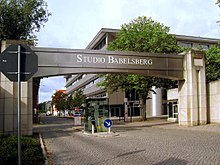
Founded in 1912, the Babelsberg Studio most Berlin was the first large-scale motion-picture show studio in the world, and the forerunner to Hollywood. It still produces global blockbusters every yr.
The making and showing of motion pictures became a source of profit almost every bit soon as the process was invented. Upon seeing how successful their new invention, and its product, was in their native France, the Lumières apace set about touring the Continent to exhibit the beginning films privately to royalty and publicly to the masses. In each country, they would normally add new, local scenes to their catalogue and, quickly enough, institute local entrepreneurs in the various countries of Europe to purchase their equipment and photograph, export, import, and screen additional product commercially. The Oberammergau Passion Play of 1898[6] was the first commercial moving picture e'er produced. Other pictures shortly followed, and motion pictures became a separate industry that overshadowed the vaudeville world. Dedicated theaters and companies formed specifically to produce and distribute films, while move moving picture actors became major celebrities and allowable huge fees for their performances. By 1917 Charlie Chaplin had a contract that chosen for an almanac salary of one million dollars. From 1931 to 1956, film was also the only image storage and playback organization for idiot box programming until the introduction of videotape recorders.
In the Us, much of the film manufacture is centered effectually Hollywood, California. Other regional centers exist in many parts of the globe, such as Bombay-centered Bollywood, the Indian film manufacture's Hindi picture palace which produces the largest number of films in the globe.[7] Though the expense involved in making films has led cinema production to concentrate under the auspices of movie studios, recent advances in affordable pic making equipment accept immune independent motion picture productions to flourish.
Profit is a cardinal forcefulness in the manufacture, due to the costly and risky nature of filmmaking; many films accept large cost overruns, an instance being Kevin Costner'south Waterworld. Yet many filmmakers strive to create works of lasting social significance. The Academy Awards (also known as "the Oscars") are the most prominent picture awards in the Us, providing recognition each twelvemonth to films, based on their artistic merits. There is also a large manufacture for educational and instructional films made in lieu of or in add-on to lectures and texts. Revenue in the manufacture is sometimes volatile due to the reliance on blockbuster films released in movie theaters. The ascension of alternative home entertainment has raised questions about the future of the cinema industry, and Hollywood employment has become less reliable, particularly for medium and low-budget films.[eight]
Associated fields
Derivative bookish fields of written report may both interact with and develop independently of filmmaking, every bit in film theory and assay. Fields of academic study have been created that are derivative or dependent on the existence of film, such as picture criticism, motion picture history, divisions of film propaganda in authoritarian governments, or psychological on subliminal effects (e.one thousand., of a flashing soda can during a screening). These fields may farther create derivative fields, such as a movie review section in a newspaper or a tv guide. Sub-industries can spin off from picture, such as popcorn makers, and film-related toys (eastward.k., Star Wars figures). Sub-industries of pre-existing industries may deal specifically with film, such as product placement and other advertising inside films.
Terminology
The terminology used for describing motility pictures varies considerably between British and American English language. In British usage, the name of the medium is "moving picture". The word "movie" is understood but seldom used.[9] [10] Additionally, "the pictures" (plural) is used semi-frequently to refer to the place where movies are exhibited, while in American English this may exist called "the movies", but it is becoming outdated. In other countries, the identify where movies are exhibited may be called a cinema or movie theatre. Past contrast, in the United States, "movie" is the predominant form. Although the words "film" and "movie" are sometimes used interchangeably, "picture" is more oft used when considering artistic, theoretical, or technical aspects. The term "movies" more frequently refers to amusement or commercial aspects, as where to get for fun evening on a date. For example, a book titled "How to Empathise a Film" would probably be nearly the aesthetics or theory of film, while a volume entitled "Let's Go to the Movies" would probably be about the history of entertaining movies and blockbusters.
Further terminology is used to distinguish various forms and media used in the pic manufacture. "Move pictures" and "moving pictures" are frequently used terms for film and picture productions specifically intended for theatrical exhibition, such as, for instance, Batman. "DVD" and "videotape" are video formats that can reproduce a photochemical picture show. A reproduction based on such is called a "transfer." Later on the advent of theatrical motion picture as an manufacture, the television manufacture began using videotape every bit a recording medium. For many decades, record was solely an analog medium onto which moving images could be either recorded or transferred. "Film" and "filming" refer to the photochemical medium that chemically records a visual prototype and the act of recording respectively. However, the human action of shooting images with other visual media, such every bit with a digital camera, is still called "filming" and the resulting works often chosen "films" as interchangeable to "movies," despite non being shot on moving picture. "Silent films" demand non be utterly silent, but are films and movies without an audible dialogue, including those that take a musical accompaniment. The word, "Talkies," refers to the earliest sound films created to have aural dialogue recorded for playback along with the film, regardless of a musical accompaniment. "Picture palace" either broadly encompasses both films and movies, or it is roughly synonymous with motion picture and theatrical exhibition, and both are capitalized when referring to a category of art. The "silvery screen" refers to the projection screen used to showroom films and, by extension, is also used every bit a metonym for the entire film industry.
"Widescreen" refers to a larger width to height in the frame, compared to before historic attribute ratios.[eleven] A "feature-length film", or "feature flick", is of a conventional total length, usually lx minutes or more, and tin can commercially stand by itself without other films in a ticketed screening.[12] A "short" is a film that is not as long as a feature-length movie, ofttimes screened with other shorts, or preceding a feature-length film. An "independent" is a film made outside the conventional moving picture industry.
In US usage, i talks of a "screening" or "project" of a motion-picture show or video on a screen at a public or private "theater." In British English, a "movie showing" happens at a cinema (never a "theatre", which is a different medium and place birthday).[x] A cinema usually refers to an arena designed specifically to showroom films, where the screen is affixed to a wall, while a theater usually refers to a identify where live, non-recorded action or combination thereof occurs from a podium or other blazon of stage, including the amphitheater. Theaters can notwithstanding screen movies in them, though the theater would exist retrofitted to do so. 1 might propose "going to the cinema" when referring to the action, or sometimes "to the pictures" in British English, whereas the US expression is usually "going to the movies." A cinema ordinarily shows a mass-marketed film using a front end-project screen process with either a film projector or, more recently, with a digital projector. But, cinemas may also show theatrical movies from their abode video transfers that include Blu-ray Disc, DVD, and videocassette when they possess sufficient projection quality or based upon demand, such as movies that be only in their transferred state, which may be due to the loss or deterioration of the moving picture master and prints from which the picture show originally existed. Due to the advent of digital film production and distribution, physical film might be absent entirely. A "double feature" is a screening of two independently marketed, stand-alone feature films. A "viewing" is a watching of a motion picture. "Sales" and "at the box role" refer to tickets sold at a theater, or more than currently, rights sold for individual showings. A "release" is the distribution and often simultaneous screening of a film. A "preview" is a screening in accelerate of the main release.
Any film may also accept a "sequel", which portrays events following those in the film. Helpmate of Frankenstein is an early on example. When there are more films than one with the aforementioned characters, story arcs, or subject themes, these movies become a "series," such equally the James Bond series. And, existing exterior a specific story timeline commonly, does not exclude a film from existence part of a series. A film that portrays events occurring earlier in a timeline with those in another film, but is released subsequently that film, is sometimes called a "prequel," an case beingness Butch and Sundance: The Early on Days.
The "credits," or "end credits," is a list that gives credit to the people involved in the production of a picture show. Films from before the 1970s usually showtime a film with credits, ofttimes catastrophe with only a title card, proverb "The Finish" or some equivalent, oftentimes an equivalent that depends on the language of the production[ citation needed ]. From and then onward, a film'southward credits usually appear at the terminate of most films. However, films with credits that finish a film often repeat some credits at or most the showtime of a film and therefore announced twice, such as that pic's acting leads, while less often some appearing near or at the get-go just announced there, not at the end, which oftentimes happens to the director's credit. The credits appearing at or near the outset of a film are usually called "titles" or "commencement titles." A mail-credits scene is a scene shown afterwards the end of the credits. Ferris Bueller'due south Day Off has a post-credit scene in which Ferris tells the audition that the picture is over and they should become dwelling house.
A film'due south "cast" refers to a collection of the actors and actresses who appear, or "star," in a film. A star is an histrion or actress, often a popular i, and in many cases, a glory who plays a central character in a picture. Occasionally the word can also be used to refer to the fame of other members of the crew, such as a manager or other personality, such as Martin Scorsese. A "crew" is usually interpreted every bit the people involved in a flick's concrete construction outside cast participation, and it could include directors, film editors, photographers, grips, gaffers, set decorators, prop masters, and costume designers. A person can both be part of a film'south cast and crew, such as Woody Allen, who directed and starred in Have the Coin and Run.
A "film goer," "film goer," or "flick buff" is a person who likes or oftentimes attends films and movies, and any of these, though more oftentimes the latter, could also meet oneself as a student to films and movies or the filmic process. Intense interest in films, film theory, and motion picture criticism, is known every bit cinephilia. A flick enthusiast is known as a cinephile or cineaste.
Preview
A preview performance refers to a showing of a moving picture to a select audience, usually for the purposes of corporate promotions, before the public film premiere itself. Previews are sometimes used to judge audience reaction, which if unexpectedly negative, may issue in recutting or even refilming certain sections based on the audience response. Ane example of a motion picture that was changed after a negative response from the examination screening is 1982'southward First Blood. Later on the test audience responded very negatively to the death of protagonist John Rambo, a Vietnam veteran, at the end of the moving-picture show, the visitor wrote and re-shot a new catastrophe in which the character survives.[xiii]
Trailers or previews are advertisements for films that will be shown in 1 to 3 months at a cinema. Back in the early on days of movie theater, with theaters that had only one or ii screens, only certain trailers were shown for the films that were going to exist shown there. Later, when theaters added more screens or new theaters were congenital with a lot of screens, all different trailers were shown even if they weren't going to play that film in that theater. Film studios realized that the more trailers that were shown (even if it wasn't going to be shown in that particular theater) the more patrons would get to a different theater to see the motion-picture show when it came out. The term "trailer" comes from their having originally been shown at the stop of a moving picture program. That practice did non last long considering patrons tended to leave the theater later the films ended, but the name has stuck. Trailers are now shown before the motion-picture show (or the "A film" in a double feature program) begins. Picture trailers are also common on DVDs and Blu-ray Discs, likewise as on the Net and mobile devices. Trailers are created to be engaging and interesting for viewers. As a event, in the Internet era, viewers ofttimes seek out trailers to watch them. Of the ten billion videos watched online annually in 2008, film trailers ranked tertiary, after news and user-created videos.[14] Teasers are a much shorter preview or advertisement that lasts only 10 to 30 seconds. Teasers are used to get patrons excited almost a film coming out in the next six to twelve months. Teasers may exist produced even earlier the film production is completed.
The Office of Film In Civilisation
Films are cultural artifacts created by specific cultures, facilitating intercultural dialogue. It is considered to be an of import art class that provides entertainment and historical value, often visually documenting a period of time. The visual basis of the medium gives information technology a universal ability of communication, often stretched farther through the use of dubbing or subtitles to translate the dialog into other languages.[15] Just seeing a location in a flick is linked to college tourism to that location, demonstrating how powerful the suggestive nature of the medium tin can be.[16]
Education and Propaganda
Film is used for a range of goals, including education and propaganda due its power to effectively intercultural dialogue. When the purpose is primarily educational, a film is called an "educational film". Examples are recordings of academic lectures and experiments, or a moving-picture show based on a archetype novel. Film may be propaganda, in whole or in part, such as the films fabricated past Leni Riefenstahl in Nazi Federal republic of germany, U.s. war pic trailers during World War II, or artistic films made under Stalin by Sergei Eisenstein. They may as well be works of political protest, as in the films of Andrzej Wajda, or more subtly, the films of Andrei Tarkovsky. The same film may be considered educational by some, and propaganda by others as the categorization of a moving picture can be subjective.
Production
At its core, the means to produce a picture show depend on the content the filmmaker wishes to bear witness, and the apparatus for displaying information technology: the zoetrope only requires a series of images on a strip of paper. Film production can, therefore, have every bit footling as one person with a photographic camera (or even without a camera, as in Stan Brakhage's 1963 moving-picture show Mothlight), or thousands of actors, extras, and coiffure members for a alive-activeness, characteristic-length epic. The necessary steps for about whatsoever pic can exist boiled downwards to conception, planning, execution, revision, and distribution. The more involved the production, the more significant each of the steps becomes. In a typical production bike of a Hollywood-mode picture, these primary stages are defined as evolution, pre-production, production, post-production and distribution.
This product cycle ordinarily takes iii years. The commencement yr is taken upward with development. The second yr comprises preproduction and production. The third twelvemonth, post-production and distribution. The bigger the product, the more resources it takes, and the more than important financing becomes; most feature films are creative works from the creators' perspective (east.chiliad., picture show director, cinematographer, screenwriter) and for-profit business entities for the production companies.
Crew
A moving picture crew is a group of people hired by a film company, employed during the "production" or "photography" phase, for the purpose of producing a picture show or motion picture. Crew is distinguished from cast, who are the actors who appear in forepart of the camera or provide voices for characters in the pic. The coiffure interacts with but is also distinct from the product staff, consisting of producers, managers, company representatives, their administration, and those whose primary responsibleness falls in pre-product or post-production phases, such as screenwriters and film editors. Communication betwixt production and crew generally passes through the director and his/her staff of assistants. Medium-to-large crews are by and large divided into departments with well-defined hierarchies and standards for interaction and cooperation between the departments. Other than acting, the crew handles everything in the photography phase: props and costumes, shooting, sound, electrics (i.e., lights), sets, and production special effects. Caterers (known in the film manufacture as "craft services") are usually non considered role of the crew.
Technology
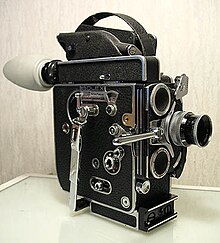
Moving picture stock consists of transparent celluloid, acetate, or polyester base coated with an emulsion containing light-sensitive chemicals. Cellulose nitrate was the first blazon of film base used to record motion pictures, but due to its flammability was somewhen replaced by safer materials. Stock widths and the film format for images on the reel have had a rich history, though most large commercial films are still shot on (and distributed to theaters) as 35 mm prints. Originally moving moving picture motion picture was shot and projected at various speeds using hand-cranked cameras and projectors; though 1000 frames per minute (16 two / three frame/s) is generally cited as a standard silent speed, research indicates most films were shot between 16 frame/s and 23 frame/southward and projected from eighteen frame/southward on up (ofttimes reels included instructions on how fast each scene should be shown).[17] When sound film was introduced in the late 1920s, a constant speed was required for the sound head. 24 frames per second were called because information technology was the slowest (and thus cheapest) speed which allowed for sufficient sound quality.[ commendation needed ] Improvements since the late 19th century include the mechanization of cameras – assuasive them to record at a consistent speed, serenity camera pattern – assuasive audio recorded on-set to be usable without requiring large "blimps" to encase the camera, the invention of more sophisticated filmstocks and lenses, allowing directors to movie in increasingly dim weather condition, and the evolution of synchronized sound, allowing audio to exist recorded at exactly the same speed every bit its corresponding action. The soundtrack tin be recorded separately from shooting the film, but for live-action pictures, many parts of the soundtrack are ordinarily recorded simultaneously.
As a medium, moving-picture show is not limited to move pictures, since the engineering adult every bit the footing for photography. Information technology tin can be used to present a progressive sequence of still images in the grade of a slideshow. Film has also been incorporated into multimedia presentations and often has importance as primary historical documentation. However, celebrated films have problems in terms of preservation and storage, and the motion movie manufacture is exploring many alternatives. Most films on cellulose nitrate base of operations take been copied onto modernistic safety films. Some studios relieve color films through the use of separation masters: three B&W negatives each exposed through cherry-red, green, or blue filters (essentially a opposite of the Technicolor process). Digital methods have also been used to restore films, although their continued obsolescence cycle makes them (as of 2006) a poor selection for long-term preservation. Pic preservation of decaying film stock is a matter of business concern to both film historians and archivists and to companies interested in preserving their existing products in lodge to make them bachelor to future generations (and thereby increase revenue). Preservation is more often than not a higher concern for nitrate and single-strip color films, due to their loftier decay rates; black-and-white films on safety bases and colour films preserved on Technicolor imbibition prints tend to keep up much ameliorate, assuming proper handling and storage.
Some films in recent decades accept been recorded using analog video applied science like to that used in idiot box production. Modern digital video cameras and digital projectors are gaining ground as well. These approaches are preferred by some picture show-makers, especially because footage shot with digital cinema can be evaluated and edited with non-linear editing systems (NLE) without waiting for the film stock to be candy. The migration was gradual, and as of 2005, most major motion pictures were still shot on film.[ needs update ]
Independent
Contained filmmaking often takes identify exterior Hollywood, or other major studio systems. An independent film (or indie motion picture) is a picture initially produced without financing or distribution from a major picture show studio. Creative, business and technological reasons have all contributed to the growth of the indie pic scene in the late 20th and early on 21st century. On the business side, the costs of big-budget studio films also lead to conservative choices in bandage and crew. At that place is a trend in Hollywood towards co-financing (over two-thirds of the films put out past Warner Bros. in 2000 were articulation ventures, upward from ten% in 1987).[18] A hopeful director is near never given the opportunity to go a job on a large-budget studio motion picture unless he or she has significant manufacture experience in film or television. Likewise, the studios rarely produce films with unknown actors, specially in atomic number 82 roles.
Before the advent of digital alternatives, the cost of professional person movie equipment and stock was besides a hurdle to being able to produce, direct, or star in a traditional studio film. But the advent of consumer camcorders in 1985, and more importantly, the inflow of high-resolution digital video in the early 1990s, have lowered the technology barrier to film production significantly. Both production and post-production costs have been significantly lowered; in the 2000s, the hardware and software for mail service-production can be installed in a commodity-based personal computer. Technologies such equally DVDs, FireWire connections and a wide variety of professional and consumer-form video editing software make pic-making relatively affordable.
Since the introduction of digital video DV technology, the ways of production have become more democratized. Filmmakers can conceivably shoot a film with a digital video camera and edit the film, create and edit the sound and music, and mix the final cut on a loftier-finish home estimator. However, while the means of production may be democratized, financing, distribution, and marketing remain difficult to accomplish outside the traditional system. Most independent filmmakers rely on film festivals to get their films noticed and sold for distribution. The arrival of internet-based video websites such as YouTube and Veoh has further inverse the filmmaking landscape, enabling indie filmmakers to make their films available to the public.
Open content movie
An open content film is much like an independent film, but it is produced through open up collaborations; its source material is available under a license which is permissive enough to let other parties to create fan fiction or derivative works, than a traditional copyright. Like independent filmmaking, open source filmmaking takes place outside Hollywood, or other major studio systems.For example, the motion picture Balloon was based on the real consequence during the Common cold State of war.[nineteen]
Fan film
A fan film is a film or video inspired by a picture, boob tube programme, comic volume or a similar source, created by fans rather than by the source's copyright holders or creators. Fan filmmakers have traditionally been amateurs, only some of the most notable films take really been produced past professional person filmmakers equally film school grade projects or equally demonstration reels. Fan films vary tremendously in length, from curt false-teaser trailers for non-existent motion pictures to rarer full-length motion pictures.
Distribution

Flick distribution is the process through which a picture show is fabricated bachelor for viewing by an audition. This is normally the chore of a professional movie benefactor, who would determine the marketing strategy of the film, the media by which a picture show is to be exhibited or fabricated bachelor for viewing, and may ready the release date and other matters. The movie may be exhibited directly to the public either through a movie theater (historically the chief mode films were distributed) or television set for personal domicile viewing (including on DVD-Video or Blu-ray Disc, video-on-demand, online downloading, telly programs through broadcast syndication etc.). Other ways of distributing a picture include rental or personal purchase of the picture in a variety of media and formats, such as VHS tape or DVD, or Internet downloading or streaming using a computer.
Animation

An animated paradigm of a horse, fabricated using 8 pictures.
Animation is a technique in which each frame of a flick is produced individually, whether generated every bit a figurer graphic, or by photographing a drawn paradigm, or by repeatedly making small changes to a model unit of measurement (encounter claymation and end move), and then photographing the upshot with a special animation camera. When the frames are strung together and the resulting film is viewed at a speed of 16 or more frames per second, there is an illusion of continuous movement (due to the phi miracle). Generating such a film is very labor-intensive and wearisome, though the development of figurer blitheness has profoundly sped up the process. Because animation is very time-consuming and often very expensive to produce, the majority of animation for TV and films comes from professional animation studios. However, the field of independent animation has existed at least since the 1950s, with animation existence produced by independent studios (and sometimes by a unmarried person). Several independent animation producers have gone on to enter the professional person animation industry.
Limited animation is a way of increasing product and decreasing costs of animation past using "short cuts" in the animation procedure. This method was pioneered by UPA and popularized past Hanna-Barbera in the United States, and past Osamu Tezuka in Nihon, and adapted past other studios as cartoons moved from film theaters to television receiver.[20] Although most animation studios are now using digital technologies in their productions, there is a specific manner of blitheness that depends on film. Camera-less animation, made famous past movie-makers like Norman McLaren, Len Lye, and Stan Brakhage, is painted and drawn directly onto pieces of film, and and then run through a projector.
Run across likewise
- Docufiction (hybrid genre)
- Filmophile
- Lost moving picture
- The Movies, a simulation game about the motion-picture show industry, taking place at the dawn of picture palace
- Lists
- Bibliography of film by genre
- Glossary of move motion-picture show terms
- Index of video-related manufactures
- List of film awards
- List of film festivals
- List of film periodicals
- Listing of years in film
- Lists of films
- List of books on films
- Outline of movie
- Platforms
- Television moving picture
- Web film
Notes
- ^ Severny, Andrei (September 5, 2013). "The Movie theatre of the Future Volition Exist In Your Listen". Tribeca. Archived from the original on September vii, 2013. Retrieved September 5, 2013.
- ^ "film | Etymology, origin and meaning of movie past etymonline". world wide web.etymonline.com . Retrieved 2022-02-01 .
- ^ Streible, Dan (xi April 2008). Fight Pictures: A History of Boxing and Early on Cinema. University of California Printing. p. 46. ISBN9780520940581.
- ^ Nelmes, Jill (2004). An introduction to motion picture studies (3rd ed., Reprinted. ed.). London: Routledge. p. 394. ISBN978-0-415-26269-9.
- ^ Ebert, Roger (October 25, 1986). "Sid and Nancy". Chicago Sunday-Times . Retrieved May 31, 2020 – via RogerEbert.com.
- ^ Couvares, Francis G. (2006). Movie Censorship and American Culture. Univ of Massachusetts Press. ISBN978-i-55849-575-3.
- ^ Bollywood Hots Up Archived 2008-03-07 at the Wayback Machine cnn.com. Retrieved June 23, 2007.
- ^ Christopherson, Susan (2013-03-01). "Hollywood in decline? US film and telly producers beyond the era of fiscal crisis". Cambridge Journal of Regions, Economic system and Society. 6 (ane): 141–157. doi:ten.1093/cjres/rss024. ISSN 1752-1378.
- ^ "British English language/American English language Vocabulary". Archived from the original on 21 June 2013. Retrieved 26 June 2013.
- ^ a b "British English vs. U.S. English – picture vs. movie". Straight Dope Message Board. 21 March 2006. Archived from the original on 10 January 2014. Retrieved 26 June 2013.
- ^ "Motion-picture show Terminology Glossary: Due west". IMDb. Archived from the original on 2010-07-22.
- ^ "Movie Terminology Glossary: F". IMDb. Archived from the original on 2010-07-22.
- ^ "'Commencement Blood' Turns 30: Rambo's original night cease". Yahoo! Movies. 22 October 2012. Archived from the original on 17 Nov 2016. Retrieved sixteen November 2016.
- ^ "AWFJ Stance Poll: All About Motion picture Trailers". AWFJ. 2008-05-09. Archived from the original on 2013-12-03.
- ^ "How people greet each other in TV serial and dubbing: Veronica Bonsignori, Silvia Bruti", The Languages of Dubbing, Peter Lang, 2015, doi:10.3726/978-3-0351-0809-5/thirteen, ISBN9783034316460 , retrieved 2022-01-24
- ^ Tooke, Nichola; Baker, Michael (1996-03-01). "Seeing is believing: the consequence of picture show on visitor numbers to screened locations". Tourism Direction. 17 (2): 87–94. doi:10.1016/0261-5177(95)00111-5. ISSN 0261-5177.
- ^ "Silent Film Speed". Cinemaweb.com. 1911-12-02. Archived from the original on April vii, 2007. Retrieved 2010-11-25 .
- ^ Amdur, Meredith (2003-eleven-sixteen). "Sharing Pix is Risky Concern". Variety. Archived from the original on September 15, 2007. Retrieved June 23, 2007.
- ^ Films, Distrib (2021-01-02). "Recommended Films". Peace Review. 33 (1): 170–172. doi:10.1080/10402659.2021.1956155. ISSN 1040-2659. S2CID 239028670.
- ^ Savage, Mark (2006-12-19). "Hanna Barbera's golden age of animation". BBC News. Archived from the original on 2006-12-nineteen. Retrieved 2007-01-25 .
References
- Acker, Ally (1991). Reel Women: Pioneers of the Cinema, 1896 to the Present. New York: Continuum. ISBN0-8264-0499-v.
- Basten, Fred E. (1980). Glorious Technicolor: The Movies' Magic Rainbow . Cranbury, NJ: Equally Barnes & Visitor. ISBN0-498-02317-half-dozen.
- Basten, Fred E. (writer); Peter Jones (director and author); Angela Lansbury (narrator) (1998). Glorious Technicolor (Documentary). Turner Classic Movies.
- Casetti, Francesco (1999). Theories of Cinema, 1945–1995. Austin, TX: University of Texas Press. ISBN0-292-71207-3.
- Melt, Pam (2007). The Movie house Book, 3rd Edition. London: British Film Plant. ISBN978-1-84457-193-2.
- Faber, Liz & Walters, Helen (2003). Blitheness Unlimited: Innovative Curt Films Since 1940 . London: Laurence Male monarch, in association with Harper Blueprint International. ISBN1-85669-346-five.
- Hagener, Malte & Töteberg, Michael (2002). Film: An International Bibliography. Stuttgart: Metzler. ISBN3-476-01523-viii.
- Loma, John & Gibson, Pamela Church (1998). The Oxford Guide to Flick Studies. Oxford; New York: Oxford University Press. ISBN0-19-871124-7.
- King, Geoff (2002). New Hollywood Cinema: An Introduction. New York: Columbia University Press. ISBN0-231-12759-six.
- Ledoux, Trish, & Ranney, Doug, & Patten, Fred (1997). Consummate Anime Guide: Japanese Animation Film Directory and Resources Guide. Issaquah, WA: Tiger Mountain Press. ISBN0-9649542-v-7.
{{cite book}}: CS1 maint: uses authors parameter (link) - Merritt, Greg (2000). Celluloid Mavericks: A History of American Contained Film. New York: Thunder'southward Mouth Press. ISBNi-56025-232-4.
- Nowell-Smith, Geoffrey (1999). The Oxford History of World Cinema . Oxford; New York: Oxford Academy Press. ISBN0-19-874242-8.
- Rocchio, Vincent F. (2000). Reel Racism: Confronting Hollywood's Construction of Afro-American Culture . Boulder, CO: Westview Press. ISBN0-8133-6710-seven.
- Schrader, Paul (Jump 1972). "Notes on Pic Noir". Film Comment. 8 (1): viii–13. ISSN 0015-119X.
- Schultz, John (writer and director); James Earl Jones (narrator) (1995). The Making of 'Jurassic Park' (Documentary). Amblin Amusement.
- Thackway, Melissa (2003). Africa Shoots Back: Culling Perspectives in Sub-Saharan Francophone African Film. Bloomington, IL: Indiana Academy Printing. ISBN0-85255-576-8.
- Vogel, Amos (1974). Motion-picture show as a Subversive Fine art. New York: Random House. ISBN0-394-49078-nine.
Further reading
- Burton, Gideon O., and Randy Astle, jt. eds. (2007). "Mormons and Film", entire special issue, B.Y.U. Studies (Brigham Young University), vol. 46 (2007), no. ii. 336 p., ill. ISSN 0007-0106
- Hickenlooper, George (1991). Reel [sic] Conversations: Candid Interviews with Film's Foremost Directors and Critics, in series, Citadel Printing Book[s]. New York: Carol Publishing Group. xii, 370 p. ISBN 0-8065-1237-vii
- Thomson, David (2002). The New Biographical Lexicon of Film (4th ed.). New York: A.A. Knopf. ISBN0-375-41128-3.
- Jeffrey Zacks (2014). Flicker: Your Brain on Movies. Oxford University Printing. ISBN978-0199982875.
External links
- Allmovie – Data on films: actors, directors, biographies, reviews, cast and production credits, box office sales, and other movie data.
- Film Site – Reviews of classic films
- Movies at Curlie
- Rottentomatoes.com – Movie reviews, previews, forums, photos, cast info, and more.
- The Internet Picture Database (IMDb) – Information on current and historical films and cast listings.
Source: https://en.wikipedia.org/wiki/Film

Post a Comment for "According to Film Art Realism Is the Most Useful Standard for Evaluating Actorsã¢â⢠Performances"