what type of stars fuse elements up to carbon
The End Of The Sun
The Helium Flash
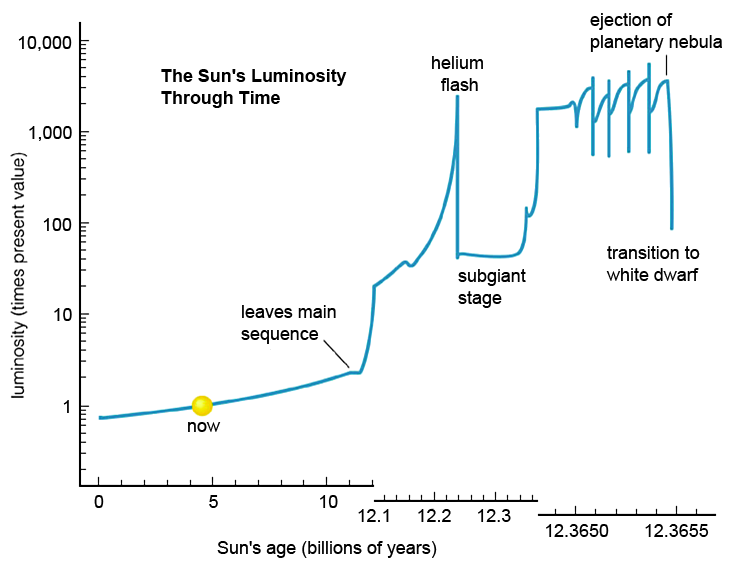
The beginning of the end for a cherry-red giant the mass of our Sun occurs very suddenly. As the helium "ashes" continue to pile upwardly at its heart, a higher fraction of them turn electron-degenerate. It is an odd paradox: even as the outer layers of a ruby-red giant star are expanding into a huge but tenuous cloud, its inner core is contracting down to form a buried white dwarf. The temperature and pressure in the Sun's cadre will soar to ten times their current values. And roughly 1.2 billion years after it leaves the chief sequence, at the height of its glory as a red giant, the center of the helium cadre of the Dominicus will become sufficiently massive, dense, and hot that something amazing will happen: within a matter of minutes, it will ignite and fire.
When the temperature in the core reaches virtually 100 meg degrees, the helium volition brainstorm to fuse into carbon by a reaction known as the triple-alpha procedure, because information technology converts three helium nuclei into i carbon cantlet. This generates a cracking deal of estrus. Notwithstanding, unlike when the Sun was immature and its core contained normal thing, calculation more oestrus to the electron-degenerate helium does not cause it to expand and cool. As I noted when I was discussing quantum mechanics, electron-degenerate matter behaves more than similar a liquid than a gas when y'all heat it: its temperature swiftly rises, but information technology doesn't aggrandize. In other words, the self-regulating mechanism that keeps main-sequence stars so stable (hydrostatic equilibrium) is turned off in electron-degenerate matter. If you add together rut to a white dwarf, it only gets hotter.
As it happens, the triple-blastoff process is exceptionally highly temperature dependent: doubling the temperature of the reaction causes it to run roughly a trillion times faster! And then, as the fusing helium heats the cadre, which cannot expand to cool downward, the increased temperature causes the helium fusion to of a sudden go on millions of times faster, which very quickly heats the cadre even more than, which in plow causes the helium to fuse style, fashion faster . . .
In brusk, the center of the helium core explodes. Virtually six% of the electron-degenerate helium core, which by at present weighs in at almost 40% of a solar mass, is fused into carbon within a few minutes. (This corresponds to burning roughly ten World masses of helium per 2d, if you are keeping score.) For obvious reasons, astronomers call this the helium flash. In roughly the time information technology takes to toast a bagel, the flash releases as much energy as our current Sun generates in 200 million years. At the elevation of the flash, the Sun's core volition very briefly equal the combined luminosity of all the stars in the Milky way galaxy! One might imagine that a conflagration of this magnitude would have a dramatic impact on the red giant – and it does, in a way, simply non virtually so all of a sudden or violently as you lot might think.
This is considering we tend to underestimate gravity. Compared to the intimidating ability of nuclear weaponry, the energy generated by dropping a few rocks doesn't seem very impressive. But in fact, the gravitational energy of extremely dense, extremely big masses is startling – it is simply our human prejudice, arising from the fact that we live on a puny pebble that is neither massive nor dense, which makes usa think otherwise.
Navigation Menu
Introduction
Matter Nether Pressure
The Nativity Of The Sun
The Lord's day's Evolution
The Finish Of The Sun
How Large Stars Evolve
Type Two – The Other Supernova
After The Supernova
Suppose we do take the Earth equally an example of a large, dense object, even though it is near every bit dumbo equally cotton candy when compared to a white dwarf. To inflate the Earth to twice its size – that is, to lift the mass of the Earth confronting its own gravity until its radius is doubled – would crave all the solar energy hit the surface of the Globe (a mere 185,000,000,000 megawatts) for the side by side 13 one thousand thousand years!
During the helium flash, a star's degenerate core is heated so intensely that information technology finally "vaporizes", so to speak. That is, individual nuclei begin moving so fast that they can "boil abroad" and escape it. The core reverts dorsum into a (spectacularly dense) normal gas, and powerfully expands. The enormous gravitational energy needed to aggrandize 100,000 Globe masses out of degeneracy and up to several times their original book is on a par with the energy release of the helium flash. Or in other words, nearly all the free energy of the wink is absorbed by the titanic weight-lifting necessary to lift the core out of its white-dwarf status. Essentially none of the energy reaches the surface of the red giant, and indeed, if yous were observing the red giant with your naked centre equally its helium core flashed over, it is doubtful that you'd notice annihilation at all.
So, by homo standards, the helium flash is a disappointing dud to watch. By galactic standards, however, the red giant has been shot through the heart. The sudden expansion of the core results in cooling so severe that information technology is something like the onset of an Water ice Age. The cooling immediately leads to much lower force per unit area in the hydrogen-burning beat that surrounds the cadre, and therefore to a calamitous drop in the energy output. On a timescale which is almost instantaneous compared to the usual timescale that stars run on (mayhap as footling as x,000 years), the carmine behemothic's diameter and luminosity plummet to less than 2% of their one-time values. For stars the mass of our Sun, the event of the helium flash is a plummet into an orangeish-yellow star with perhaps ten times the current solar bore and 40 times the luminosity. It is quite a comedown.
The Stop Of The Lord's day
The terminal 140 million years or and so of the Sun's life volition be very complicated. Later on its collapse, as illustrated in Figure 1, the Dominicus will reestablish itself as a star with a double energy source: it volition have a dense (but non electron-degenerate) carbon-oxygen core surrounded by a shell where helium is called-for into carbon, and outside of that it volition accept some other shell where hydrogen is burning into helium. (The core oxygen is created by slow fusion between carbon and helium at the core's surface. In heavier stars, the oxygen can in plow fuse with the helium to make neon.) Helium fusion produces only 9% as much energy per kilogram as hydrogen fusion, then free energy-wise, the Sun continues to exist mainly a hydrogen reactor. 90% of its luminosity still comes from burning hydrogen.
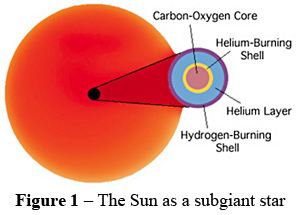
However, it is the helium surrounding the cadre which now dictates how the Sun will evolve. The Sun more-or-less repeats what it did as a aging chief-sequence star, except now with a carbon-helium mix in the cadre rather than a helium-hydrogen mix. For a time it achieves relative stability and maintains hydrostatic equilibrium in its new incarnation as an orangeish-yellowish "subgiant" star. Thus, stars in this stage of their being are sometimes said to be on the "helium master sequence". From the fleeting perspective of a human lifetime, subgiant stars seem calm enough: the well-known bright star Arcturus, whose light was used to open the 1933 Chicago World'due south Fair, is such a star. It has not changed in any measurable mode since the invention of the telescope.
But the loftier temperatures necessary to maintain helium burning mean that the Sun can but burn helium ane way: very fast. The hot core dictates rapid hydrogen burning as well. When it was on the normal main sequence, the Sun'due south luminosity held fairly close to 1.0 Lo for effectually nine billion years before brightening to virtually ii.7 Lo at the end. On the helium main sequence, the Sunday's luminosity will hold at most 45 50o earlier brightening to almost 110 Fiftyo at the end. Not so impressive as a cerise giant, but very brilliant nonetheless.
To maintain its subgiant lifestyle the Sun must tear through the fuel in its helium core 100 times faster than it did with its original hydrogen core. Later only a hundred million years on the helium main sequence, the Sun will in one case again begin to climb towards the realm of the blood-red giants, and for the same reasons as it did earlier. Just there is no "carbon wink" equivalent of the helium flash that stopped the Sun the first time. The temperature and pressure needed to ignite carbon-carbon fusion is also great for the Sun to reach no affair how compressed its core becomes, so the carbon just accumulates and becomes ever denser. The trend that the Dominicus showed on its first run as a cerise behemothic, when its cadre was crushed to white dwarf densities fifty-fifty as the outer layers billowed to tens of millions of kilometers in diameter, is unstoppable now. The Dominicus becomes a scarlet giant once more, this fourth dimension with a pinnacle luminosity above 3,000 Lo. Its outer layers blow further and further outward, beyond the orbit of Jupiter, fifty-fifty as its electron-degenerate core swiftly grows more massive and therefore smaller and more dense.
And eventually the day comes when the 2 part company. The final days of a star are extremely complicated, considering the helium-burning and hydrogen-called-for shells don't burn down at the aforementioned charge per unit. The hotter, faster-burning helium shell tends to race outwards and overtake the hydrogen-burning shell, and when that happens at that place is no more helium left to burn, and so the helium beat fizzles out. Just the giant star quickly cooks up more than helium, which and then collects on the white-dwarf core until it suddenly flares upwardly in a run-away helium ignition that is something like a baby version of a helium core wink. The helium flare-upward disrupts (turns off) the hydrogen burning for a short time, and so it goes. At the very end, the Sunday will literally cough itself to death as multiple fuel ignitions and choked-off fusion extinguishments rip through its atmosphere.
In four or five huge bursts, spaced roughly 100,000 years apart, the outer layers of the Sun will separate from the core and be completely blown abroad. They will form an enormous, expanding crush around the solar system, and motion outward to rejoin the interstellar gas. Roughly 45% of the Dominicus'south mass will escape in this way. The remaining 55% of the Sun'due south mass is soon compressed into the white-hot, ultra-dumbo core. To someone watching the Sunday from far away, the Lord's day would appear to quickly shift colors from red to white as the gaseous veil surrounding it is lifted. (Past "quickly", of grade, I mean a time span simply a few times longer than the age of the pyramids.)
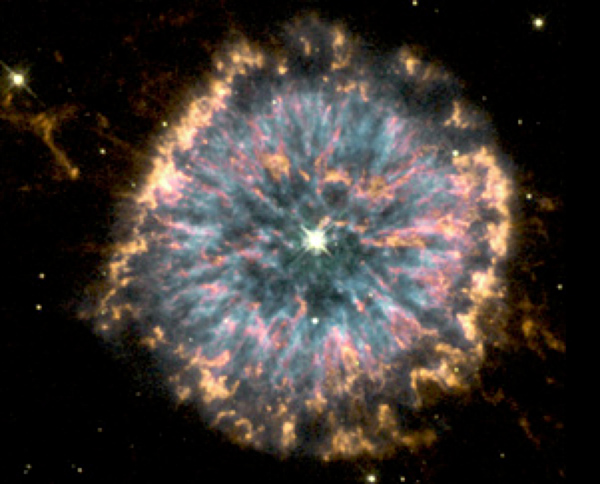 The exposed surface of the searing solar core will be so hot, at least 170,000 K°, that it will emit more x-rays than visible light. (Postal service-cerise-giant stars are the hottest stars known, excepting neutron stars.) Its luminosity will exist a bright 4,000 Lo. The Sunday will have become a radiations source of truly galactic stature, its energy lighting up the escaping gas around it similar a huge neon sign. Such clouds are called planetary nebula, a misleading proper noun, because 18th-century astronomers could barely run into them with the telescopes of the time and idea that they looked similar planets. They are among the well-nigh beautiful sights in astronomy. The photograph at correct, of the nebula known as NGC 6751, is of one of my favorites. The bright spot in the center is the post-cherry-red-giant parent star.
Remarkably, there is a star right at the point of bravado off its outer layers which can be seen with the naked eye. This is Mira, the "Amazing Ane", so named by Arabian astronomers in the Middle Ages considering Mira rather erratically varies over a bridge of roughly 330 days from existence the brightest star in its constellation (Cetus, the Whale) to total invisibility. Mira is the only classically named star that you cannot see, much of the time. Modernistic instruments reveal that Mira is a vastly over-extended handbag of deep-ruby-red gas that is not even closely spherical and which, at 2,000 Thousand°, is also one of the coolest stars known. Its atmosphere is undergoing complex undulations and oscillations as the nuclear burning below it sputters and gasps. Hence, its variability. In a paltry 500,000 years or less, Mira volition be a planetary nebula.
As for the Lord's day, without its outer layers to supply information technology with more than hydrogen, it tin simply maintain the gorgeous display of its nebula for a few one thousand years, inappreciably more than a snap of the fingers by galactic standards. The last dregs of fuel on the dense core will finally burn out, and for the commencement time in over twelve billion years the Lord's day volition terminate to produce energy. The nebula will disperse and fade. The Lord's day has become a white dwarf, little larger than
the Globe just 200,000 times more massive, and for billions of years to come all it volition do is slowly absurd off.
Due to their immense density, the time it takes white dwarfs to cool off is then nifty that not even the oldest known (nearly 12 billion years) accept had time to absurd much beneath 5000 K°. These very one-time "white dwarfs" could perhaps more accurately be called "yellowish-white" dwarfs, but in any example, the Milky Way does not contain any "black dwarfs". All of the 10 billion or and so white dwarf stars that our galaxy has produced since the Big Bang are nevertheless shining, even so dimly.
Belarusian, Bosnian, Croatian, Estonian, Finnish, French, Hungarian, Lithuanian, Macedonian, Mongolian, Norwegian, Shine, Romanian, Russian, Serbian, Spanish, Swedish, Thai, Ukrainian, Uzbek
Source: https://faculty.wcas.northwestern.edu/infocom/The%20Website/end.html

Post a Comment for "what type of stars fuse elements up to carbon"